Showing posts with label Mechanics of Solids. Show all posts

Wednesday, July 30, 2014

Laws of Friction

free body diagram of body sliding in friction
The sliding of a solid body in contact with another solid body is always opposed by  force of friction. Friction acts in the direction opposite to that of relative motion and it is tangential to the surface of two bodies at the point of contact.
Friction is a necessary in every machine because it involves wearing of machine component and consumes energy that transfers into heat. In come cases friction is desirable in case for functioning of a machine, such as belt drives, friction clutches.

The Five Laws of Friction:

  1. When a body is moving, the friction is directly proportional to normal force and frictional force direction is perpendicular to the normal force.
  2. Friction doesn't depend on the area of contact so long as there is an area of contact.
  3. The coefficient of static friction is slightly higher the value than the coefficient of kinetic friction.
  4. Kinetic friction is independent of velocity of the body.
  5. Friction depends upon the type of the surfaces in contact.

Sunday, June 29, 2014

Lami's Theorem

In statics, Lami's theorem is an equation that relates the magnitudes of three coplanar, concurrent and non-collinear forces, that keeps a body in static equilibrium.
Lami’s theorem states that if three forces acting at a point are in equilibrium, each force is proportional to the sine of the angle between the other two forces.
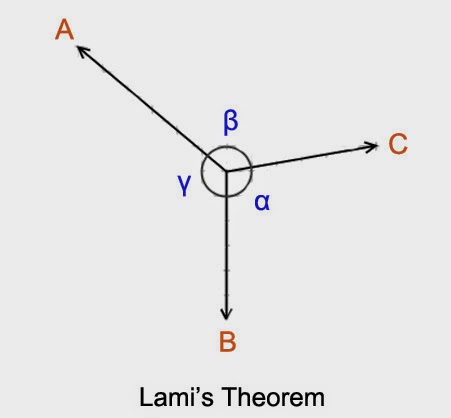
Consider three forces A, B, C acting on a particle or rigid body making angles α, β and γ with each other.

Lami's Theorem

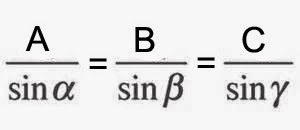
According to Lami’s theorem , the particle shall be in equilibrium if
Lami's Theorem condition
The angle between the force vectors is taken when all the three vectors are emerging from the particle.

Friday, June 20, 2014

Newton's Laws of Motion

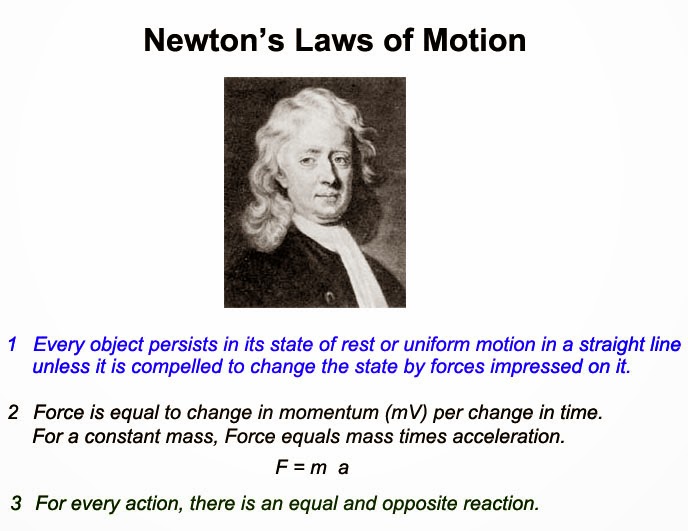
Newton's three laws of motion

Newton’s First Law of Motion :

Newton’s first law of motion states that every object will remain at rest or in uniform  motion in a straight line unless compelled to its state by the action of an external force.
The first law of motion is normally taken as the definition of inertia. If there is no net force acting on an object then object will remain a constant velocity. If an external force is applied, the velocity of body will change because of force.

Newton’s Second law of Motion :

Newton’s Second law of motion states that if the resultant force acting on a particle is not zero, the particle will have acceleration proportional to the magnitude of the resultant and in the direction of this resultant force.  This law explains how velocity of an object changes when it is subjected to an external force. The law defines force to be equal to change in momentum (mass times velocity) per unit time.
For an object  with constant mass m, Newton’s second law of motion states that the force 'F' is the product of an object’s mass 'm' and its acceleration 'a'.
F = m.a
For an externally applied force, the acceleration depends on mass of the object and a change in velocity will generate a force. The above equation works in both ways.

Newton’s Third Law of Motion :

Newton’s third law of motion states that for every action (force) in nature there is an equal and opposite reaction. In other words, if object 'A' exerts a force on object 'B', then object 'B' also exerts an equal force on object 'A'.
The third law of motion can be used to explain the generation of lift by a wing and the production of thrust by a jet engine.